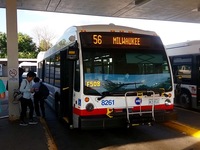
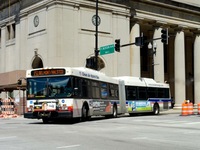
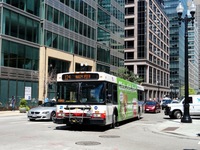
At its monthly board meeting today, the Chicago Transit Board approved the purchase of up to 100 new 60-foot articulated buses from New Flyer of America, Inc. The $80 million deal is a reassignment of options from a contract with New Flyer originally executed by Seattle’s King County Metro.
While the specific models being purchased have yet to be identified, the CTA says that the order will contain a mix of 67 “clean-diesel” and 33 hybrid diesel-electric articulated buses. The new buses will allow CTA to begin replacement of its 40-foot Nova bus fleet, which have begun to reach end of life.
Delivery is expected to commence late this year and will be completed in 2013.
This isn’t the first time that the CTA has worked with King County Metro to assume contract options. The CTA’s 2007 order of 150 New Flyer DE60LF buses, numbered 4000-4149, was also the result of a reassignment of options from the Seattle-based transit agency.
Yesterday, at a planning open house hosted by the Chicago Architecture Foundation, the Chicago Department of Transportation unveiled design options for the upcoming Central Loop BRT corridor.
The $37 million project will involve bus priority lanes along Canal, Clinton, Washington, and Madison. The corridor will be used by six CTA bus routes, including the #14, #20, #56, #60, #124, and #157. Funding will be provided by a combination of federal grants and local tax increment financing (TIF) funds.
CDOT unveiled three design directions for the bus priority lanes: Basic, Balanced, and Focused. Each would involve transportation improvements for both buses and cyclists.

Example of the “Basic” design option on Washington. (click to enlarge)

Example of the “Balanced” design option on Washington. (click to enlarge)

Example of the “Focused” design option on Madison. (click to enlarge)
The “Basic” improvement is the simplest and most cost effective of the three. It would involve bus-only lanes that would occasionally be shared with turning traffic, along with “queue jumps” that would allow buses to proceed ahead of vehicular traffic at selected intersections.
The “Balanced” option would add level boarding stations at bus stops. Each station would tentatively include canopies and accommodate at least two 60-foot long articulated buses.
The third “Focused” option is the more drastic and expensive of the three alternatives. This design would created a bi-directional busway on Madison while prohibiting vehicular traffic. Only a single turning lane would be provided. CDOT notes that this option exceeds their current funding and thus would require additional funding sources.
Neither of the plans may involve pre-paid boarding, often seen as a key feature of BRT service. According to consultants on hand at yesterday’s meeting, pre-paid boarding would present several operational challenges that would need to be addressed by the CTA.
In addition to bus priority lanes and other BRT features, the project will include construction of a Union Station Transit Center on Jackson just south of Union Station. The transit center will include sheltered boarding areas with room for 12 buses to layover. Direct access to Union Station will also be provided via the pedway.
Moving forward, CDOT hopes to complete the necessary steps to secure their FTA grants by September 2012. Design and engineering would take place over the following year, with construction beginning in 2014.
In addition to the Central Loop BRT, CDOT is working with CTA on two other BRT projects. Later this year, BRT service will begin along the Jeffrey Corridor. Oft-described as “BRT lite,” this project will involve rush hour bus priority lanes along Jeffrey between 67th and 83rd streets. A much larger project that would involve BRT service along either Ashland or Western is currently in the early planning stages. CDOT also unveiled that they recently secured funds to begin designing a detailed system plan for BRT. That work will commence late this year.
Further Reading: